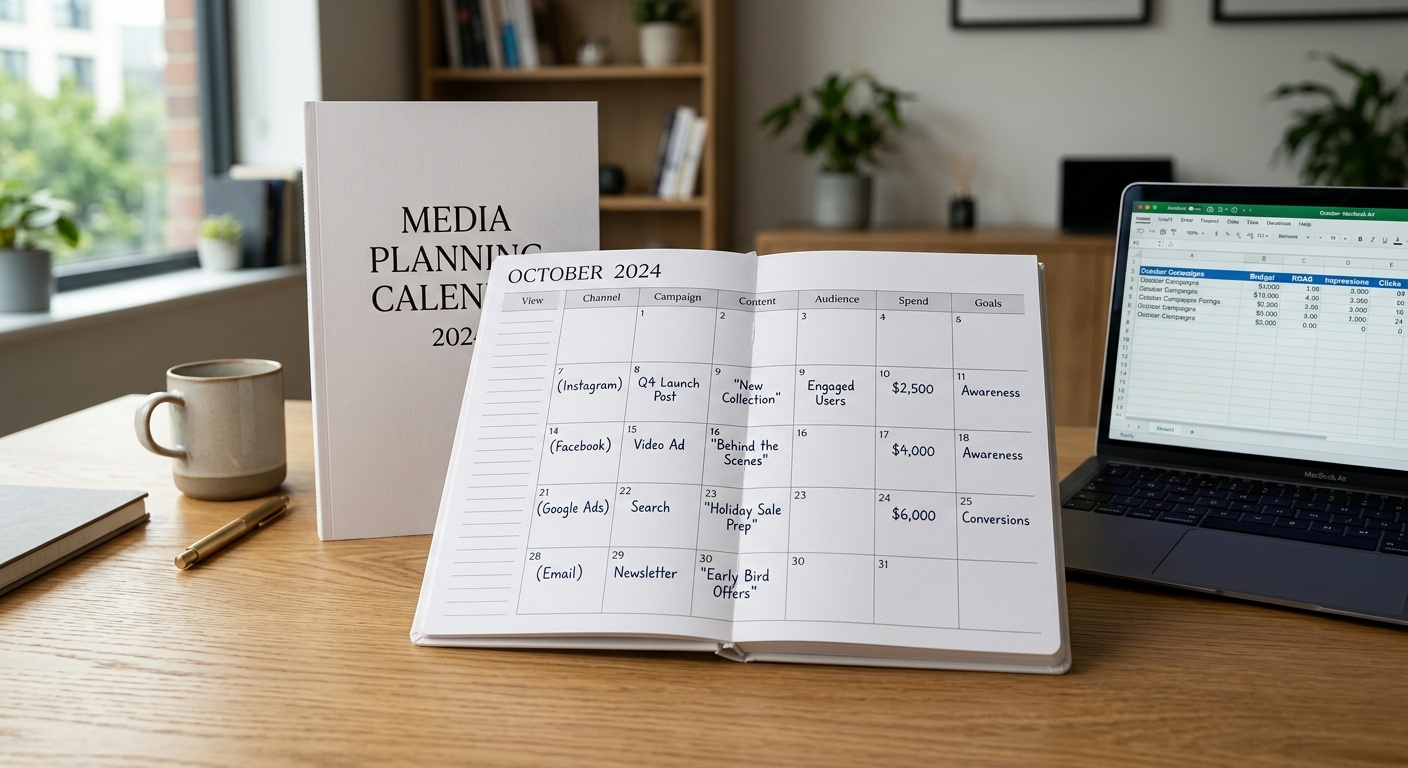
Media Planning Essentials Every Growing Brand Needs to Understand in 2026
Reading time: 14 minutes
Ever launched a campaign that felt brilliant on paper but delivered disappointingly thin results? You’re not alone. In 2026, the media landscape has never been more complex — or more full of opportunity — for brands willing to plan strategically rather than spend reactively.
Here’s the straight talk: media planning isn’t just about choosing where to run ads. It’s the art and science of connecting the right message to the right audience at exactly the right moment — and doing it efficiently enough to actually grow your bottom line. With global digital ad spend projected to surpass $820 billion in 2026, the brands winning are those who treat planning as a competitive weapon, not an administrative chore.
Whether you’re a scrappy DTC brand figuring out your first media mix, or a scaling mid-market company trying to optimize cross-channel ROI, this guide breaks down everything you need to know — practically, clearly, and without the jargon fog.
Table of Contents
- What Is Media Planning (and Why Most Brands Get It Wrong)
- The Core Components of a Winning Media Plan
- Navigating the Channel Landscape in 2026
- Budgeting Frameworks That Actually Work
- Measurement, Attribution, and the Metrics That Matter
- Real-World Case Studies: Lessons from 2025 Campaigns
- Common Media Planning Challenges and How to Overcome Them
- Channel Effectiveness at a Glance
- Frequently Asked Questions
- Your 2026 Media Planning Action Plan
What Is Media Planning (and Why Most Brands Get It Wrong)
Media planning is the strategic process of determining how, where, when, and to whom you deliver your advertising messages to achieve specific business objectives. It involves selecting the optimal combination of media channels, timing, frequency, and budget allocation to maximize impact relative to cost.
Sounds straightforward. So why do so many brands still stumble?
The most common mistake is confusing media buying with media planning. Buying is transactional — it’s the execution of purchasing ad inventory. Planning is strategic — it’s the thinking that should happen before a single dollar is committed. When brands skip or rush the planning phase, they end up with misaligned messaging, wasted impressions, and campaigns that generate activity without results.
A second critical mistake: planning based on where your competitors are spending rather than where your audience actually lives and makes decisions. In 2026, with fragmented attention across streaming platforms, connected TV, short-form video, podcasts, and AI-curated feeds, assumption-based planning is a fast track to budget hemorrhage.
“The biggest shift in media planning isn’t the technology — it’s the mindset. Brands that win treat every dollar as a hypothesis, not a commitment.” — Dr. Lauren Fitch, Head of Media Strategy, Horizon Media Group, 2026
The Foundation: Audience Intelligence Before Everything
Before you touch a single channel or budget figure, you need to understand your audience with surgical precision. In 2026, first-party data has become the most valuable currency in media planning — particularly after the deprecation of third-party cookie frameworks and tightening global privacy regulations like the Global Privacy Accord enacted in late 2025.
Audience intelligence means going beyond demographics. It encompasses:
- Behavioral patterns — When does your audience consume content? On what device? In what context?
- Psychographic profiles — What values, fears, aspirations, and identities drive their decisions?
- Purchase journey mapping — How many touchpoints does your typical customer need before converting?
- Platform preferences by segment — Your 35–44 demographic may still skew LinkedIn and connected TV, while your 18–24 segment lives in short-form video and audio-first environments.
Pro Tip: If you don’t yet have robust first-party data, building it should be your first media investment — not an afterthought. Customer surveys, loyalty programs, CRM enrichment, and gated content are all cost-effective starting points.
The Core Components of a Winning Media Plan
A complete media plan in 2026 isn’t a spreadsheet of placements. It’s a strategic document that aligns your marketing objectives with audience insights, channel selection, creative strategy, and measurement frameworks. Here are the essential components:
1. Campaign Objectives and KPIs
Every media plan begins with clarity of purpose. Are you building brand awareness among a new audience segment? Driving purchase intent among warm prospects? Re-engaging lapsed customers? Your objective determines everything downstream — from channel mix to creative format to the metrics you’ll use to evaluate success.
Use the SMART framework rigorously here. “Increase brand awareness” is not an objective. “Increase unaided brand recall among 25–34 year old urban professionals by 12% within Q2 2026” — that’s an objective you can plan around and measure against.
2. Target Audience Definition
Build specific, data-informed audience personas. Name them, give them context, and crucially — validate them against real behavioral data. In 2026, AI-powered audience modeling tools from platforms like The Trade Desk, Magnite, and Google’s DV360 allow brands to define and reach granular custom audiences with remarkable precision.
3. Channel Mix and Flighting Strategy
Your channel mix is the blend of media environments where your ads will appear. Flighting refers to the timing and scheduling of your campaigns — whether continuous, pulsed (on-and-off bursts), or seasonal. The right combination depends on your objectives, budget, and audience behavior patterns.
4. Budget Allocation
How you distribute budget across channels, campaign phases, and audience segments is one of the most consequential decisions in your plan. We’ll explore specific frameworks in a dedicated section below.
5. Creative Requirements
A media plan without a creative strategy is like a map without a destination. Each channel has distinct creative specifications, formats, and audience expectations. Your plan should outline what creative assets are needed, in what formats, and with what messaging variations for different audience segments.
6. Measurement and Optimization Framework
Define upfront how you’ll track performance, what tools you’ll use, and at what intervals you’ll review and optimize. Build in pre-defined optimization triggers — for example, “if CTR drops below 0.8% in Week 2, shift 15% of display budget to paid social.”
Navigating the Channel Landscape in 2026
The 2026 media ecosystem is both thrilling and overwhelming. Here’s a practical breakdown of the major channel categories and their strategic roles:
Paid Social: Still Dominant, but Maturing
Meta platforms (Instagram, Facebook), TikTok, YouTube, LinkedIn, and Pinterest collectively command the largest share of digital ad budgets for most consumer brands. In 2026, short-form video advertising on TikTok and Instagram Reels continues to deliver strong awareness and consideration metrics — particularly for brands targeting under-35 audiences.
However, CPMs on paid social have risen significantly. According to Insider Intelligence’s 2026 Digital Advertising Forecast, average CPMs on Meta platforms increased 18% year-over-year in 2025, pushing brands to be more intentional about audience segmentation and creative testing.
Strategic role: Best for awareness, consideration, and retargeting. Strong for community-building and brand storytelling formats.
Connected TV (CTV) and Streaming
CTV has solidified its position as a must-have channel for brands with significant awareness objectives. With ad-supported tiers from Netflix, Disney+, Amazon Prime Video, and Peacock now reaching over 400 million households globally, CTV combines the premium storytelling environment of traditional TV with the targeting precision of digital.
In 2026, interactive CTV formats — including shoppable ads, QR-code integrations, and second-screen syncing — have made the channel significantly more performance-oriented than its broadcast TV predecessor.
Audio: The Resurgent Channel
Podcast advertising and streaming audio (Spotify, Amazon Music, Apple Music) have matured into serious performance channels, not just brand-building tools. Host-read podcast ads in particular continue to demonstrate conversion rates 3–5x higher than comparable display formats, according to the 2026 Podcast Advertising Benchmark Report.
Search: The Evergreen Performer
Google Search and Bing remain the most direct-response channels in most brand arsenals. In 2026, AI-generated search results (AI Overviews and AI-mode answers) are reshaping paid search dynamics — creating new opportunities in branded and intent-rich queries while compressing organic real estate. Brands must invest in both paid search and search-adjacent content strategies simultaneously.
Out-of-Home (OOH) and Digital OOH
Physical media is experiencing a quiet renaissance. Digital out-of-home (DOOH) — dynamic digital billboards, transit screens, and retail media displays — now offers programmatic buying, real-time audience data, and contextual targeting that rival digital channels. For brands in urban markets or retail environments, DOOH is a powerful brand-reinforcement tool.
Budgeting Frameworks That Actually Work
One of the most anxiety-inducing aspects of media planning is budget allocation. How much should you spend? How should you divide it? What if you’re wrong?
Here’s a practical framework used by leading growth brands in 2026:
The 70-20-10 Rule
- 70% of budget goes to proven, high-confidence channels and audiences
- 20% goes to emerging channels or new audience segments with strong potential
- 10% is reserved for genuine experimentation — new formats, beta platform placements, or creative hypothesis testing
This framework prevents two common failure modes: the brand that over-concentrates risk in one channel and collapses when performance shifts, and the brand that spreads budget so thin across experimental channels that nothing gets a fair test.
Funnel-Based Allocation
A second framework maps budget to the purchase funnel. A commonly recommended split for growing brands in 2026 is:
- Upper funnel (awareness): 30–40% of budget — CTV, social video, audio, display
- Mid funnel (consideration): 30–35% — paid social, content marketing, native advertising, YouTube
- Lower funnel (conversion): 25–35% — paid search, retargeting, shopping ads, email integration
The exact split depends on your brand’s maturity, competitive context, and current awareness levels. A new brand needs to invest more heavily in upper funnel before lower-funnel tactics can perform efficiently.
Measurement, Attribution, and the Metrics That Matter
In a post-cookie, AI-accelerated media environment, measurement has become both more sophisticated and more contested. Here’s how to navigate it intelligently:
Moving Beyond Last-Click Attribution
Last-click attribution — crediting the final touchpoint before conversion with all the value — has been recognized as a deeply flawed model for years, yet many brands still default to it because it’s simple. In 2026, with customer journeys spanning an average of 7–12 touchpoints across devices and channels (per Salesforce’s State of Marketing 2026 Report), last-click models systematically undervalue upper-funnel investment and bias budgets toward bottom-funnel channels.
Superior alternatives include:
- Data-driven attribution (DDA): Uses machine learning to assign credit fractionally across all touchpoints based on actual conversion contribution. Available natively in Google Analytics 4 and major DSPs.
- Media Mix Modeling (MMM): Statistical models that measure the aggregate impact of all media inputs on business outcomes. Experiencing a major resurgence in 2026 as privacy constraints limit user-level tracking.
- Incrementality testing: Controlled experiments (holdout tests) that measure the true causal impact of specific media channels on conversions. Considered the gold standard for channel-level validation.
The Metrics Hierarchy
Not all metrics are created equal. Build a clear hierarchy:
- Primary business metrics: Revenue, customer acquisition cost (CAC), return on ad spend (ROAS), market share
- Leading performance indicators: Conversion rate, cost per acquisition (CPA), qualified lead volume
- Channel efficiency metrics: CPM, CPC, CTR, view-through rate
- Brand health metrics: Aided/unaided awareness, brand consideration, net promoter score (NPS) movement
Too many brands optimize obsessively on channel metrics (CPM, CTR) while losing sight of whether their media investment is actually moving business outcomes. Build your measurement framework top-down, from business objective to the channel-level signals that correlate with that objective.
Real-World Case Studies: Lessons from 2025 Campaigns
Case Study 1: Fable & Thread — DTC Apparel Brand Scales with Integrated Planning
Fable & Thread, a sustainable DTC apparel brand based in Amsterdam, was struggling with declining ROAS on paid social as CPMs rose throughout 2024. By early 2025, they restructured their media plan around an integrated approach: 35% of budget shifted to podcast advertising and CTV (targeting eco-conscious consumers in their 30s), while paid social was repositioned purely as a retargeting and community engagement tool.
The result? A 31% reduction in overall CAC by Q3 2025, with podcast-driven customers showing 2.4x higher lifetime value than those acquired through paid social alone. The key insight: channel selection must align with audience purchase psychology, not just reach efficiency.
Case Study 2: Meridian Health Systems — B2B Media Planning for Complex Buyer Journeys
Meridian Health Systems, a healthcare SaaS platform, faced the challenge of reaching hospital procurement decision-makers — a notoriously difficult, niche audience with a 9–14 month average sales cycle. Their 2025 media plan abandoned broad digital display in favor of a precision-focused strategy: LinkedIn Sponsored Content targeting healthcare executives by job function and institution size, supported by a high-quality podcast series distributed on niche medical administration channels.
By creating an educational content hub and using media to drive qualified traffic rather than direct conversion, Meridian increased Marketing Qualified Lead (MQL) volume by 47% year-over-year while reducing cost per MQL by 22%. The lesson: for complex B2B sales, media planning is about building relationships and credibility, not just generating clicks.
Common Media Planning Challenges and How to Overcome Them
Challenge 1: Limited Budget, Unlimited Channel Options
The problem: With dozens of viable media channels available, brands with limited budgets often spread thin and achieve mediocrity across everything rather than excellence in a few places.
The solution: Apply the minimum effective dose principle. Identify the 2–3 channels where your specific audience has the highest concentration and where your budget can achieve meaningful frequency (ideally 3–5+ impressions per unique user per month). Dominate those channels before expanding.
Challenge 2: Proving Media ROI to Internal Stakeholders
The problem: Marketing leaders often struggle to connect media spend to business outcomes in language that resonates with CFOs and CEOs who think in revenue, not impressions.
The solution: Build a measurement translation layer. Map media KPIs to revenue outcomes before the campaign launches. For example: “If our conversion rate holds at 2.3% and average order value is $95, we need X qualified visitors from media to generate Y in revenue. At our target CPC, that requires $Z in paid search investment.” This kind of forward-looking financial modeling makes media planning a business conversation, not a marketing one.
Challenge 3: Staying Current in a Rapidly Evolving Landscape
The problem: New platforms, formats, AI tools, and privacy regulations are emerging faster than most planning teams can track. In 2026, brands that planned their media approach in 2024 and haven’t revisited core assumptions are likely misallocating significant budget.
The solution: Institute quarterly media landscape reviews as a formal discipline. Subscribe to authoritative industry sources (eMarketer, WARC, Nielsen Annual Reports). Build relationships with platform partners who can provide early access to beta formats. And critically — never let your media plan go more than 90 days without a structured performance review and reallocation conversation.
Channel Effectiveness at a Glance: 2026 Performance Index
The following visualization compares key media channels on a composite effectiveness index (0–100) based on targeting precision, cost efficiency, brand safety, and conversion potential for mid-market brands in 2026:
2026 Media Channel Effectiveness Index (Mid-Market Brands)
Source: Composite index based on eMarketer 2026 data, Insider Intelligence benchmarks, and platform performance averages. Index reflects general mid-market applicability and will vary by industry and audience.
Comparative Overview: Media Planning Approaches
| Approach | Best For | Key Advantage | Primary Risk | 2026 Relevance |
|---|---|---|---|---|
| Reach Maximization | New brand launches, awareness phases | Broad exposure, market entry | Low frequency, weak recall | High — especially via CTV+Social |
| Frequency Optimization | Consideration stage, competitive markets | Deep message retention | Ad fatigue, narrow audience | High — requires creative rotation |
| Performance Targeting | Lower funnel, direct response | Measurable ROI, conversion focus | Undervalues brand building | Critical — core of most plans |
| Contextual Targeting | Privacy-first environments | Brand safety, relevance without cookies | Less precise audience match | Growing fast post-cookie era |
| Integrated Omnichannel | Mature brands, complex journeys | Holistic brand experience | High complexity, attribution difficulty | Highest potential, requires expertise |
Frequently Asked Questions
How much should a growing brand realistically budget for media planning in 2026?
There’s no universal answer, but a practical rule of thumb for growing brands is to allocate 7–12% of projected annual revenue to total marketing spend, with 50–65% of that going to paid media. For early-stage brands building awareness from scratch, this can stretch to 15–20% of revenue temporarily. More important than the total budget is how strategically it’s concentrated — a $50,000 media budget focused precisely on two or three high-relevance channels will consistently outperform a $150,000 budget spread thin across every available platform. Always start by identifying your minimum effective reach threshold for your core audience segment before setting a total budget figure.
How has AI changed media planning in 2026, and should brands rely on it?
AI has transformed media planning at every level in 2026 — from audience modeling and creative optimization to real-time budget reallocation and predictive campaign modeling. Tools like Google’s Performance Max, Meta’s Advantage+ suite, and independent AI planning platforms from companies like Skai and Basis Technologies now automate significant portions of tactical execution. However, the strategic layer — defining objectives, understanding audience psychology, selecting the right channel mix philosophy, and interpreting results in business context — still requires human judgment. The wisest approach is to use AI to execute more efficiently within a strategically sound framework, not to replace the strategic thinking itself. Brands that hand everything to automated systems without clear guardrails often find their budgets optimizing toward vanity metrics rather than genuine business outcomes.
How frequently should a media plan be reviewed and updated?
In 2026’s fast-moving media environment, quarterly reviews are the minimum standard for any active media plan, with monthly performance check-ins recommended for campaigns with significant budgets (over $25,000/month). However, formal plan updates — revisiting channel mix, audience definitions, and budget allocation philosophy — should happen at minimum every six months. Many sophisticated brands now operate on a rolling 13-week planning horizon, updating their forward plan continuously as new performance data and market signals emerge. The key discipline is establishing pre-defined optimization triggers so your team isn’t making reactive decisions based on emotion or short-term noise, but executing a structured, data-driven review process.
Your 2026 Media Planning Action Plan: From Strategy to Execution
You’ve absorbed a lot. Let’s make it actionable. The brands that will win in 2026 and beyond aren’t those with the biggest budgets — they’re the ones with the clearest strategies, the most disciplined measurement habits, and the agility to learn and adapt faster than their competition.
Here’s your practical roadmap to stronger media planning starting now:
- Audit your current media mix this week. Map every dollar you’re currently spending against your funnel objectives. Identify where you’re over-concentrated and where you have blind spots. This single exercise routinely reveals 15–25% budget reallocation opportunities for brands that do it honestly.
- Define or refresh your audience personas with first-party data. If your personas are more than 12 months old, they need updating. Use your CRM, customer surveys, and platform audience insights to validate who you’re really reaching — and whether that matches who you want to reach.
- Implement a measurement framework before your next campaign launch. Decide how you’ll attribute success, which metrics sit at which tier of your hierarchy, and at what intervals you’ll review. Document it before the campaign goes live.
- Run one channel experiment this quarter. Apply the 10% experimental budget principle to a channel or format you haven’t tested. Set a clear hypothesis, run the test for a statistically meaningful period, and document the learning regardless of outcome.
- Schedule a quarterly media landscape review. Block time with your team to review industry benchmarks, new platform capabilities, and emerging format opportunities. Treat it as a strategic meeting, not an operational one.
Media planning is rapidly becoming one of the defining competitive advantages separating scaling brands from stagnating ones. As AI handles more of the tactical execution, the brands that invest in strategic media thinking — deep audience understanding, disciplined measurement, and creative channel innovation — will pull further ahead in efficiency and effectiveness.
Here’s a question worth sitting with: If you had to defend every dollar of your current media spend based on evidence rather than habit, how much of it would survive that scrutiny — and what would you do differently starting tomorrow?
About the Author
