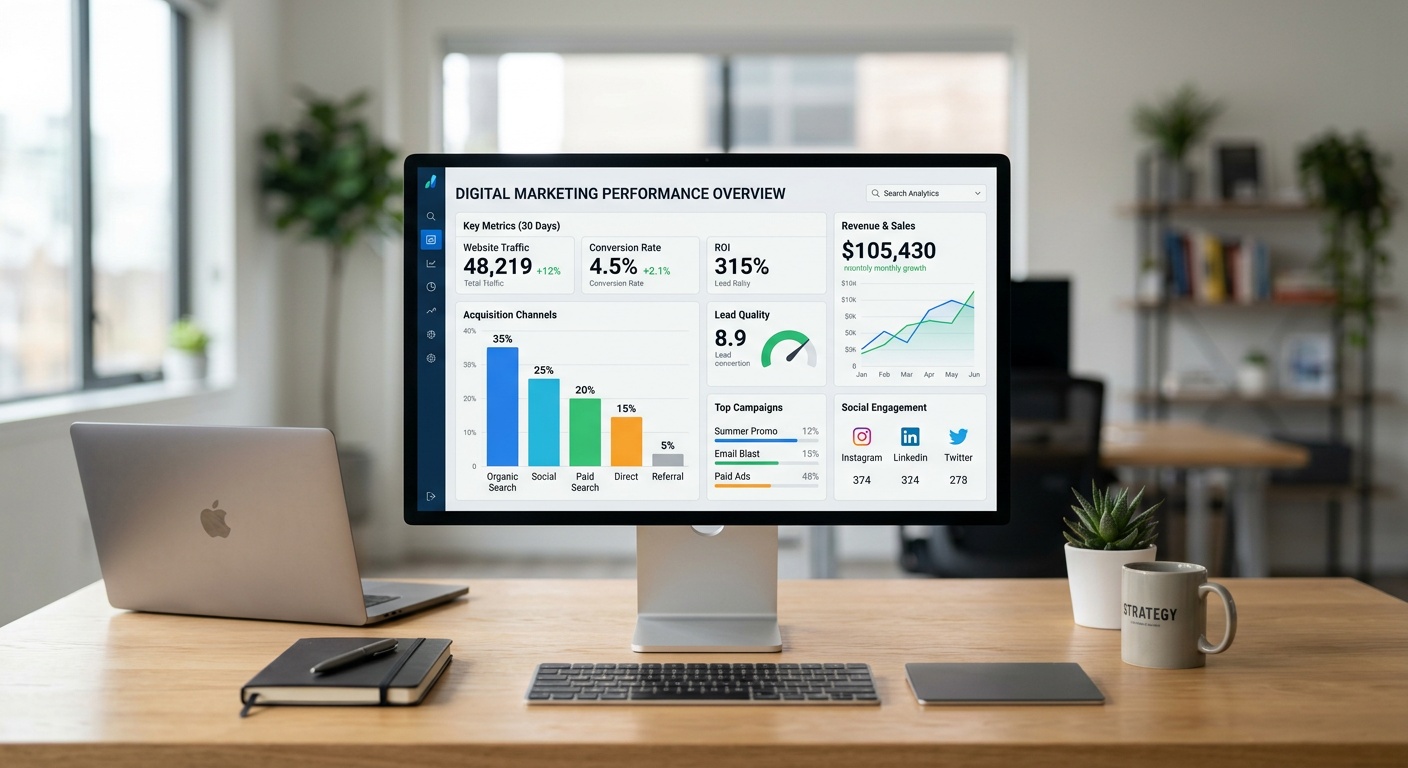
How to Choose the Best Full-Service Digital Marketing Agency for Your Brand
Reading time: 14 minutes
Ever stared at a list of 50 digital marketing agencies, all promising to “skyrocket your ROI” and “dominate your niche,” and felt completely paralyzed? You’re in excellent company. In 2026, the global digital marketing agency landscape has exploded to over 500,000 registered agencies worldwide, making the selection process feel less like a business decision and more like finding a needle in a very expensive haystack.
Here’s the straight talk: choosing the wrong agency doesn’t just waste your marketing budget — it can actively damage your brand equity, stall your growth trajectory, and cost you 6-18 months of competitive positioning. But choosing the right full-service partner? That’s the difference between a brand that treads water and one that commands its market.
This guide cuts through the noise. Whether you’re a scaling startup ready to invest seriously in marketing, or an established brand looking to consolidate your fragmented agency roster into one strategic partner, this is your practical roadmap to making a decision you won’t regret.
Table of Contents
- What Does “Full-Service” Actually Mean in 2026?
- The 7 Core Criteria for Agency Selection
- Red Flags That Should Disqualify an Agency Immediately
- Real-World Examples: What Good (and Bad) Partnerships Look Like
- Agency Type Comparison: What to Expect at Each Level
- Where Brands Are Allocating Digital Marketing Budgets in 2026
- The 10 Questions You Must Ask Before Signing
- Frequently Asked Questions
- Your Strategic Next Move: A Decision Roadmap
What Does “Full-Service” Actually Mean in 2026?
The term “full-service digital marketing agency” has been stretched, squeezed, and repackaged so many times that it’s worth defining it precisely before we go further. In 2026, a genuinely full-service agency doesn’t just run your Google Ads and post on Instagram. It functions as an integrated growth partner that connects every digital touchpoint across your customer journey.
The Core Service Pillars of a Modern Full-Service Agency
A credible full-service agency in 2026 should cover all — or a clearly defined subset — of the following capabilities:
- Search Engine Optimization (SEO): Including AI-assisted content optimization, semantic search strategies, and Core Web Vitals performance tuning
- Paid Media Management: Across Google, Meta, TikTok, LinkedIn, Amazon, and emerging platforms like Roblox advertising channels
- Content Strategy and Creation: Long-form, short-form, video, podcast, and interactive content
- Social Media Management: Community building, influencer coordination, and platform-specific creative
- Email and Marketing Automation: CRM integration, lifecycle marketing, and AI-driven personalization
- Web Design and Development: UX/UI optimization, conversion rate optimization (CRO), and technical performance
- Data Analytics and Reporting: First-party data strategies, attribution modeling, and business intelligence dashboards
- Brand Strategy: Positioning, messaging frameworks, and competitive differentiation
The critical distinction: Many agencies claim to be “full-service” but actually outsource 60-70% of their deliverables to freelancers or white-label providers. This isn’t inherently wrong, but you need to know about it upfront — because it directly affects quality control, communication timelines, and your actual cost structure.
The AI Integration Question You Need to Ask
By 2026, AI tools have become deeply embedded in every marketing discipline. According to a Forrester Research study published in early 2026, 87% of top-performing marketing agencies now use AI-assisted tools for at least four service areas simultaneously. The question isn’t whether your agency uses AI — it’s how strategically they deploy it and whether human expertise still drives creative and strategic decisions.
A genuinely sophisticated agency will use AI to accelerate data analysis, personalize content at scale, and optimize ad bidding in real time — while keeping human strategists in charge of brand voice, creative direction, and long-term positioning. Be wary of agencies that either dismiss AI entirely (they’re behind the curve) or claim AI eliminates the need for experienced human talent (they’re cutting corners).
The 7 Core Criteria for Agency Selection
Think of selecting a full-service digital marketing agency like hiring a senior executive. You wouldn’t hire a CMO without checking their track record, understanding their management style, and confirming cultural alignment. The same rigor applies here.
1. Demonstrated Industry Relevance
General expertise is valuable, but relevant expertise is irreplaceable. An agency that has consistently grown B2B SaaS companies understands buyer psychology, sales cycle complexity, and content-driven demand generation in ways that a generalist agency simply cannot replicate quickly. Ask for three to five case studies within your specific industry or business model — not just impressive logo slides.
Quick scenario: You run a direct-to-consumer wellness brand targeting women 35-55. An agency with a portfolio dominated by enterprise tech clients and automotive brands might have brilliant strategic minds, but they lack the cultural fluency, influencer relationships, and platform-specific creative instincts your category demands. Industry relevance accelerates results.
2. Transparency in Reporting and Attribution
This is where many agencies fall short — and where many brands fail to hold them accountable. In an era of complex, multi-touch customer journeys, you need an agency that can clearly articulate how their work contributes to actual business outcomes, not just vanity metrics.
Ask specifically: How do you handle attribution across channels? What does your standard reporting dashboard look like? Can I see a sample report from a current client? If the answers are vague, the relationship will be frustrating.
3. Team Seniority and Dedicated Resources
The classic agency bait-and-switch: a senior partner presents in the pitch meeting, then hands your account to a team of junior specialists once the contract is signed. Protect yourself by contractually specifying the seniority level of team members who will actively manage your account, and by requesting regular strategy reviews with senior leadership.
4. Cultural and Communication Fit
You will interact with your agency team multiple times per week. Cultural misalignment — different communication styles, mismatched expectations around responsiveness, or divergent views on creative risk-taking — creates friction that erodes results over time. Prioritize agencies where the working relationship feels energizing, not draining.
5. Pricing Structure and Value Clarity
Agency pricing in 2026 follows several models: monthly retainers, project-based fees, performance-based compensation, and hybrid structures. None is inherently superior — what matters is alignment with your business stage and risk tolerance. A startup with limited capital might prefer performance-based structures; an established brand typically benefits from the strategic depth of a comprehensive retainer model.
Pro Tip: Always ask agencies to break down their proposed retainer into specific activities, hours, and deliverables. Opacity in pricing is a reliable predictor of opacity in performance.
6. Technology Stack and Platform Partnerships
Top-tier agencies maintain active partnerships with major platforms (Google Premier Partner, Meta Business Partner, HubSpot Diamond Partner, etc.). These partnerships provide agencies with early access to beta features, dedicated platform support, and advanced training — advantages that directly benefit your campaigns.
7. Strategic Vision Beyond Execution
The most dangerous agency relationship is one that’s purely executional — where the agency does exactly what you ask without challenging your assumptions or bringing strategic perspective. The best full-service partners act as a strategic extension of your team, proactively identifying opportunities, flagging risks, and connecting marketing decisions to broader business goals.
Red Flags That Should Disqualify an Agency Immediately
Knowing what not to choose is just as valuable as knowing what to look for. Here are the non-negotiable disqualifiers:
- Guaranteed rankings or ROI promises: No ethical agency can guarantee specific Google rankings or promise a precise ROI figure before understanding your full business context. These claims are either naive or dishonest.
- Vague or non-existent case studies: “We increased traffic by 200% for a client in the retail space” without naming the client, the timeframe, the starting baseline, or the methodology is meaningless.
- No clear onboarding process: A structured onboarding process is a signal of operational maturity. Agencies that “just get started” without deep discovery work will create misaligned strategies.
- Resistance to audit your existing data: Before proposing a strategy, a competent agency should want to audit your analytics, ad accounts, and existing content performance. Reluctance to do this suggests they’re proposing generic solutions.
- Locked-in contracts with no performance clauses: Rigid, multi-year contracts with no performance benchmarks or exit provisions favor the agency, not you.
- High staff turnover signals: If you ask about team structure and discover that your account would be managed by someone with less than one year at the agency, probe further. High turnover in agencies creates institutional knowledge gaps that hurt client results.
Real-World Examples: What Good (and Bad) Partnerships Look Like
Case Study 1: The Right Match — Scaling a D2C Brand with Integrated Strategy
Scenario: A premium sustainable skincare brand based in Austin, Texas, had been managing paid social, SEO, and email marketing across three separate agencies. By early 2025, their messaging was inconsistent, attribution data was fragmented, and their customer acquisition cost had increased by 34% year-over-year despite growing their total marketing spend.
They consolidated their marketing under a single full-service agency with deep CPG and D2C experience. Within the first 90 days, the agency unified their data infrastructure under a single CDP (customer data platform), created a cohesive brand messaging framework, and restructured their paid media to reflect actual customer journey stages.
Results by Q3 2026: Customer acquisition cost decreased by 28%, email revenue contribution grew from 18% to 31% of total digital revenue, and organic search traffic increased by 67% through a coordinated content and SEO strategy.
The key insight: the consolidation itself wasn’t the magic — the integrated strategy that became possible through consolidation was the real driver.
Case Study 2: A Costly Mismatch — When Prestige Isn’t Enough
Scenario: A mid-sized B2B logistics technology company signed an 18-month contract with a large, well-known agency in 2024, impressed by their client list and sophisticated pitch deck. The agency had a strong consumer brand track record but limited B2B SaaS experience.
The problems emerged within 60 days. The content strategy focused heavily on top-of-funnel brand awareness tactics appropriate for consumer brands, not the thought leadership and technical content needed to reach logistics operations managers and procurement teams. Paid campaigns targeted broad audience segments rather than the hyper-specific job titles and company profiles that B2B demand generation requires.
The outcome: After 12 months, the company had accumulated $340,000 in agency fees with minimal pipeline impact. They exited the contract during the penalty window, taking a financial hit — but learning a lesson that saved them far more in the long run.
The key insight: prestige and industry relevance are not the same thing. Always validate specific experience in your business model and audience type.
Agency Type Comparison: What to Expect at Each Level
| Agency Type | Typical Monthly Retainer | Best For | Key Advantage | Key Risk |
|---|---|---|---|---|
| Boutique Specialist | $3,000 – $8,000 | Startups, niche brands | Deep focus, agile execution | Limited service breadth |
| Mid-Tier Full-Service | $8,000 – $25,000 | Growth-stage companies | Integrated capabilities, stronger account management | Quality inconsistency across services |
| Large Independent Agency | $25,000 – $80,000 | Established mid-market brands | Broad resources, platform access | Bait-and-switch on team seniority |
| Global Network Agency | $80,000+ | Enterprise, multinational brands | Global reach, proprietary data tools | Bureaucracy, slower execution speed |
| Performance-Only Agency | % of ad spend or revenue | E-commerce, lead generation | Aligned incentives, low upfront cost | Short-term focus, brand building neglected |
Where Brands Are Allocating Digital Marketing Budgets in 2026
Understanding current budget allocation trends helps you evaluate whether a prospective agency’s strategic recommendations align with how high-performing brands are actually investing their marketing dollars this year.
2026 Digital Marketing Budget Allocation (Average Across Mid-Market Brands)
Source: Gartner CMO Spend Survey 2026 | Based on mid-market brand averages ($10M–$250M annual revenue)
Notice how analytics and technology infrastructure claims 10% of average budgets — a figure that has nearly doubled since 2022. Brands are increasingly recognizing that data infrastructure isn’t just a back-office function; it’s a competitive advantage that multiplies the ROI of every other channel.
The 10 Questions You Must Ask Before Signing
Walk into every agency pitch meeting with these questions prepared. Their answers — and how they answer — will tell you everything you need to know.
- “Can you show me three client case studies in my industry with specific metrics?” — Evaluates relevant experience and transparency
- “Who will be working on my account day-to-day, and what is their experience level?” — Guards against the bait-and-switch
- “What does your onboarding process look like, and how long before we see first results?” — Reveals operational maturity and realistic expectations
- “How do you measure success, and what reporting will I receive?” — Tests their analytics sophistication
- “What percentage of your services are delivered in-house versus outsourced?” — Critical for quality control understanding
- “How do you incorporate AI tools into your workflow, and where does human expertise take over?” — Reveals their strategic maturity in 2026’s AI landscape
- “What happens if results plateau after six months? What’s your optimization process?” — Tests strategic depth beyond initial campaign setup
- “Can I speak with two current clients whose businesses are similar to mine?” — Nothing replaces peer references
- “What are the contract terms, and what performance benchmarks trigger a review?” — Protects your financial exposure
- “What do you think our biggest marketing challenge is, based on what you know so far?” — Tests whether they’ve actually done their homework on your brand
Pro Tip: Pay close attention to how agencies respond to question #10. The best agencies will have done competitive research and pre-discovery analysis before the pitch meeting. An agency that can’t offer a thoughtful initial hypothesis about your challenges hasn’t invested enough to earn your trust — yet.
Frequently Asked Questions
How long does it typically take to see meaningful results from a full-service digital marketing agency?
This varies significantly by channel and business context, but here’s a realistic framework: Paid media campaigns can generate measurable results within 30-60 days, though meaningful optimization typically requires 90 days of data. SEO is a 6-12 month investment before substantial organic traffic gains are visible. Email and automation programs often show strong results within 60-90 days once proper segmentation is established. A trustworthy agency will set these realistic expectations upfront — not promise you explosive results within 30 days across every channel. If they do, treat it as a red flag rather than a selling point.
Is it better to work with one full-service agency or multiple specialist agencies?
Both models have legitimate merit, and the right answer depends on your business complexity and internal marketing team capacity. A single full-service agency offers integrated strategy, unified reporting, and simpler account management — advantages that become increasingly valuable as your marketing ecosystem grows. Multiple specialist agencies can deliver deeper expertise in each channel but require a strong internal coordinator to prevent misalignment and attribution conflicts. For most companies with annual marketing budgets between $200,000 and $2 million, a single strong full-service agency with genuine multi-channel capability delivers superior results relative to the management overhead of a fragmented specialist model.
What should a realistic digital marketing agency retainer cost in 2026?
Expect to invest a minimum of $5,000-$8,000 per month for a credible full-service retainer that includes more than surface-level execution. For genuinely integrated strategy across four or more channels with senior oversight, $12,000-$30,000 monthly is typical for mid-market brands. Enterprise-level partnerships with large agencies routinely exceed $50,000-$100,000 monthly. The critical frame isn’t the absolute cost — it’s the ratio of potential revenue impact to agency fees. An agency charging $20,000 per month that generates $400,000 in incremental revenue is delivering exceptional value; one charging $8,000 that generates $60,000 in incremental revenue may be underperforming relative to potential.
Your Strategic Next Move: A Decision Roadmap
You’ve now got the framework. The question is: what do you do with it in the next 30 days? Here’s your action-oriented roadmap.
- Audit your current marketing state (Days 1-7): Before you talk to a single agency, document your existing performance baselines — website traffic, conversion rates, customer acquisition costs, revenue by channel, and the biggest gaps in your current approach. Agencies that receive a well-prepared brief will give you dramatically better proposals.
- Build a shortlist of 5-7 candidates (Days 7-14): Use industry directories like Agency Spotter or Clutch, ask peers in your network for referrals, and look for agencies that are publishing genuinely insightful content in your industry. Quality of thinking in their public content is a strong proxy for the quality of thinking you’ll receive as a client.
- Run structured pitch meetings with your 10 questions (Days 14-21): Use the same question set with every agency so you can make apples-to-apples comparisons. Ask for written proposals that include a 90-day plan, year-one success benchmarks, and a clear breakdown of deliverables.
- Check references and review contracts carefully (Days 21-28): Speak with at least two current clients per finalist agency. Engage a lawyer to review any contract longer than 12 months or above $150,000 annual value. Ensure performance benchmarks and exit clauses are clearly specified.
- Negotiate a structured onboarding with 90-day review gates (Days 28-30): The best agency relationships begin with clearly defined onboarding milestones and a formal 90-day review where both parties assess fit and recalibrate strategy based on early data.
The brands that will dominate their markets in 2027 and beyond are making these partnerships decisions with strategic precision right now. The digital marketing landscape continues to consolidate around first-party data strategies, AI-augmented personalization, and brand-building as a performance multiplier — trends that reward brands with sophisticated, integrated agency partners over those cobbling together disconnected tactical execution.
Here’s the thought to carry with you: You’re not hiring a vendor. You’re choosing a strategic partner who will co-author the next chapter of your brand’s growth story. Treat the selection process with that level of gravity — and the right agency will help you write something worth reading.
Which of the 10 questions will you lead with in your first agency conversation this week?
About the Author
